


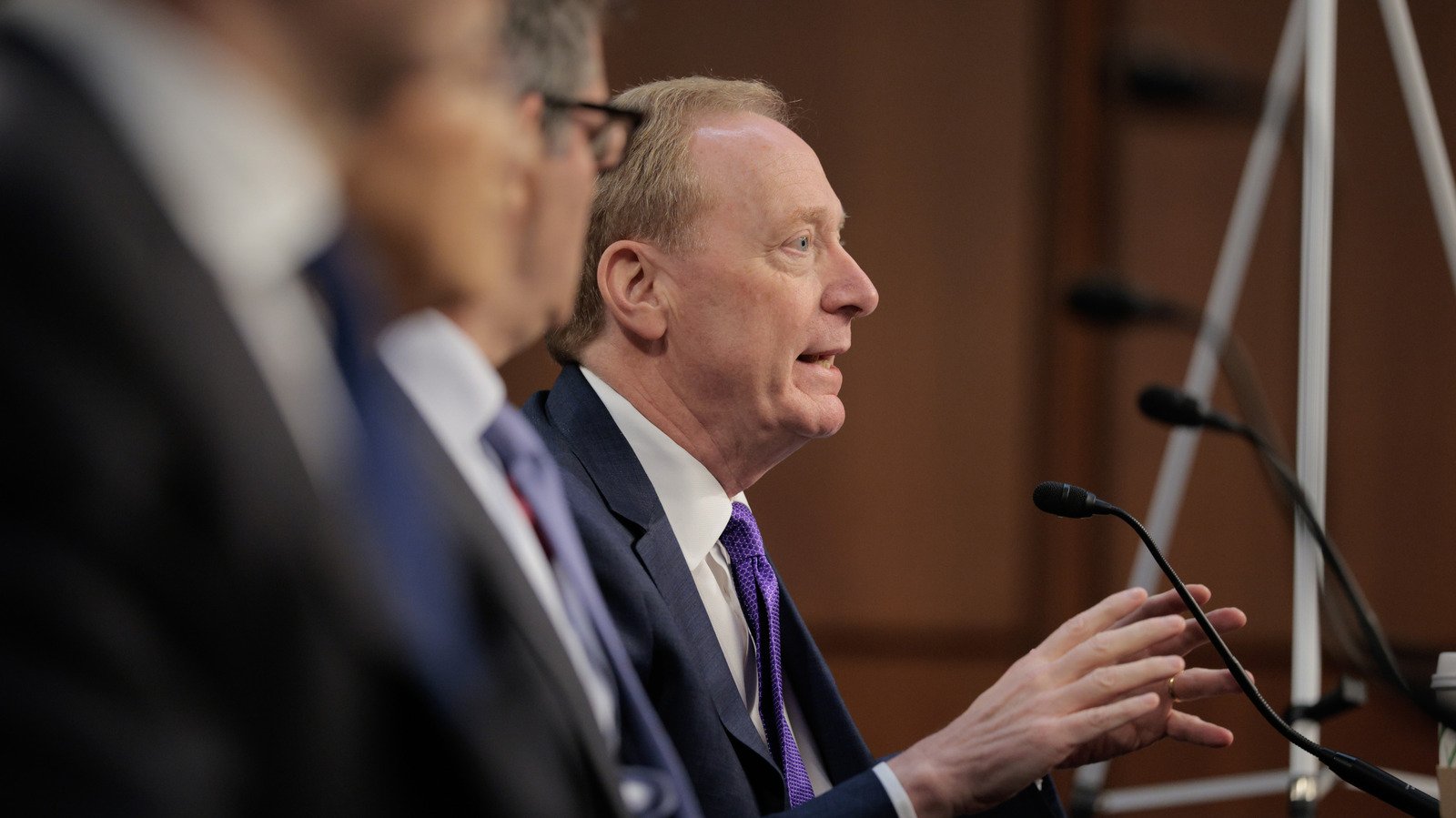
Brad Smith Says Microsoft AI Regulation Trails a Carton of Milk
Microsoft president Brad Smith has drawn an unflattering comparison between artificial intelligence and dairy products, arguing that Microsoft AI Regulation lags far behind the rules governing everyday groceries. In an interview with ITV on Friday, Smith noted that washing machines and milk cartons face stricter safety inspections than the most capable frontier models now reaching the market. Furthermore, he suggested the absence of American leadership creates a rare opening for Britain to set global standards.
Specifically, Smith pointed out that every carton of milk sitting on a grocery shelf is subject to safety rules and inspection, while advanced AI systems operate under far looser oversight. Consequently, he framed the disparity as a governance failure rather than a technical one. Moreover, he argued the gap keeps widening as model capabilities accelerate faster than lawmakers can respond.
Washington Pushes Speed While Smith Pushes Rules
Major American AI developers, including Anthropic, OpenAI, and Google’s DeepMind, have publicly backed a slower, more cautious approach to building frontier systems. However, US President Donald Trump has taken the opposite view, insisting the domestic industry must accelerate to maintain its edge over China. Therefore, the White House prefers voluntary corporate commitments over binding federal legislation. In addition, Trump has repeatedly warned that heavy-handed rules would hand Beijing a strategic advantage.
At his so-called Super Intelligence summit, several industry leaders signed a pact outlining self-regulation, safeguards to prevent pioneer models from going rogue, and the use of independent auditors to assess risk. Google’s Sundar Pichai, Anthropic’s Dario Amodei, Meta’s Mark Zuckerberg, OpenAI president Greg Brockman, Elon Musk, and NVIDIA chief Jensen Huang all attached their names. Nevertheless, the agreement carries no enforcement mechanism.
Critics Dismiss the Voluntary Pact
Analysts were unimpressed. One told the BBC that the accord lets companies define what counts as safety, while another said it should be ignored as a distraction. On the other hand, Smith sees the vacuum as an opportunity for the UK to lead the Microsoft AI Regulation conversation.
- Voluntary pledges lack independent enforcement.
- US lawmakers remain divided on binding AI statutes.
- British officials could bridge Brussels and Washington.
The UK’s Opening on Microsoft AI Regulation
Smith argued that Washington does not view London the way it views Brussels, and he called that distinction a strength. As a result, Britain can position itself as a credible middle ground between European strictness and American reticence. ‘I hope that’s the role we can play as a company,’ he said. ‘I hope that’s the role the UK can play as a country.’
Ultimately, Smith warned that models powerful enough to threaten global cybersecurity demand immediate attention. ‘When you look at models that are so powerful that they’re putting the world’s cybersecurity at risk, I would say: the moment has arrived,’ he told ITV. Overall, the executive’s message is that Microsoft AI Regulation must catch up with the milk aisle before the next generation of systems ships.
Microsoft AI Regulation Market Impact and Industry Significance
The introduction of Microsoft AI Regulation represents a pivotal shift in modern technological adoption across enterprise and consumer sectors alike. Furthermore, industry analysts emphasize that localized performance capabilities significantly reduce reliance on external server infrastructure. Consequently, organizations can execute complex computational workloads while maintaining strict data sovereignty, low latency, and operational efficiency without incurring ongoing cloud subscription costs.
Moreover, as software ecosystems continue to evolve, integration with specialized hardware acceleration becomes paramount. Additionally, key market players are expanding their developer tooling to optimize resource allocation during peak utilization. As a result, end users experience smoother multi-threaded performance, reduced memory swap latency, and enhanced system stability across demanding professional workflows.
Performance Benchmarks and Practical Microsoft AI Regulation Scenarios
In real-world deployment scenarios, evaluating sustained throughput and thermal efficiency is essential for technical decision-makers. Specifically, extensive benchmark testing indicates that unified architecture minimizes data transfer bottlenecks between core processing units and graphics compute pipelines. Therefore, demanding tasks operate with minimal compute overhead.
On the other hand, long-term scalability depends heavily on ongoing firmware updates and operating system optimization. Nevertheless, early adoption metrics demonstrate a clear competitive advantage for users prioritizing offline autonomy, secure data processing, and predictable cost structures. Ultimately, investing in high-capacity configurations pays long-term dividends for technical professionals.
Ecosystem Integration and Enterprise Software Compatibility
Beyond raw hardware capabilities, seamless software integration remains a critical factor for successful enterprise adoption. Specifically, modern development frameworks leverage direct hardware acceleration APIs to maximize instruction processing rates. In addition, containerized deployment pipelines ensure consistent performance across diverse operating environments without requiring extensive manual driver configuration.
Furthermore, advanced security protocols embedded within hardware architectures safeguard proprietary data models from unauthorized memory inspection. Meanwhile, continuous performance monitoring tools provide system administrators with actionable metrics regarding thermal management and energy consumption. Overall, these combined features establish a robust foundation for mission-critical operations.
