


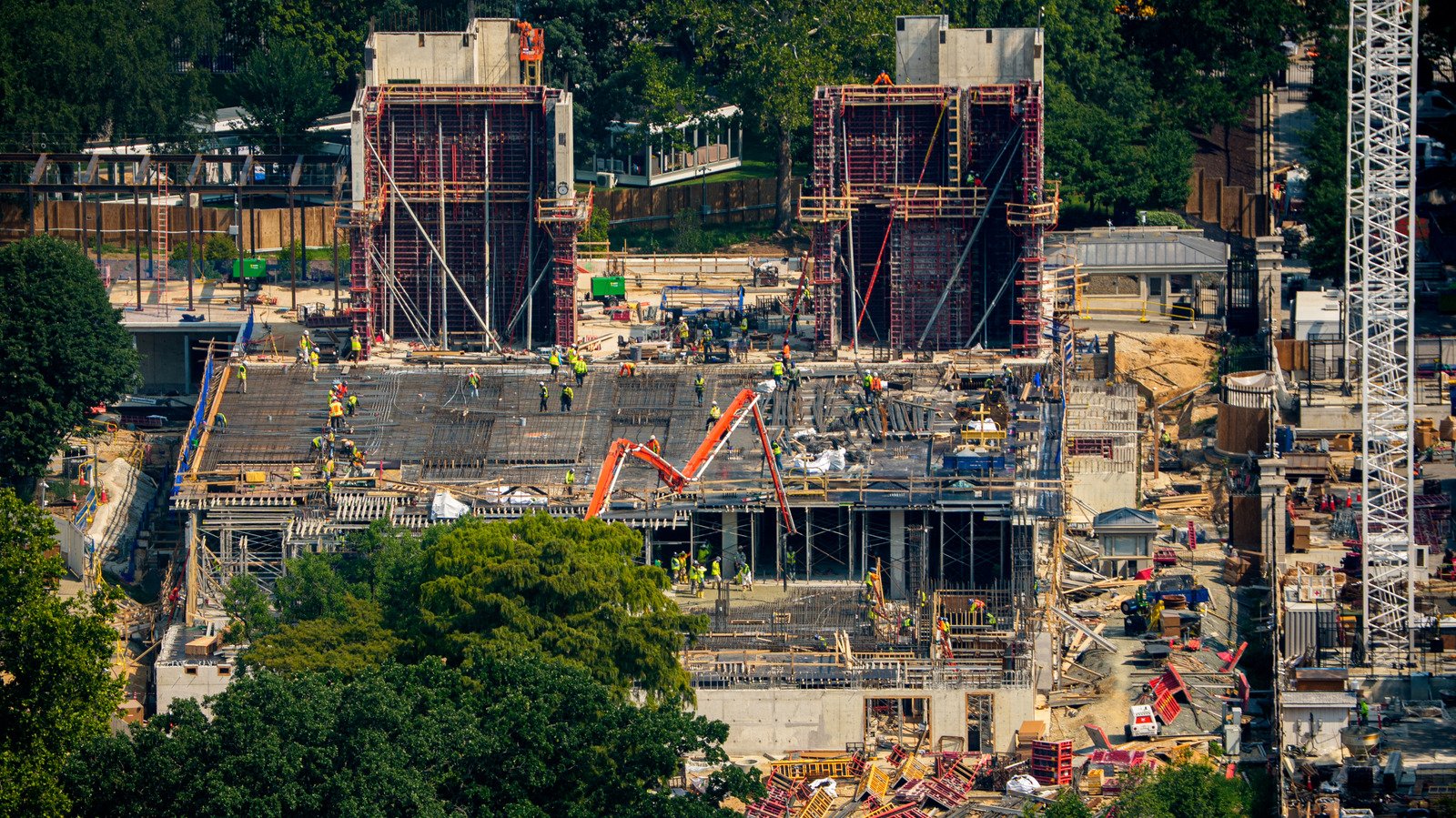
Trump ballroom project Funding Sparks Transparency Debate
The Trump ballroom project has become the center of a growing national debate as new records reveal a massive reliance on funding from tech and telecom corporations. Investigations confirm that these industries contributed over $183 million to the controversial construction. Notably, companies such as Apple and NVIDIA have each pledged $25 million to the Trump ballroom project. For many observers, these contributions represent a clear attempt by Silicon Valley to mitigate the impact of potential trade tariffs and regulatory shifts that could negatively affect their bottom lines.
Additionally, the list of donors highlights a significant trend of corporate lobbying embedded within the Trump ballroom project architecture. Firms like Palantir, Coinbase, and Lockheed Martin have joined the ranks of major contributors, signaling a broad base of institutional support. Because the funds are channeled through a nonprofit organization under the President’s direct control, there is virtually no public oversight. This lack of transparency has allowed $77 million in donations to remain completely anonymous, shielding the identity of those seeking to influence the administration.
Taxpayer Costs for Trump ballroom project Revealed
Moreover, the fiscal reality of the Trump ballroom project is far more complex than initial promises suggested. While the President previously asserted that the project would be fully funded by private supporters, current estimates suggest that taxpayers may end up footing the bill for roughly half of the $600 million total. This discrepancy between the promised private funding and the reality of taxpayer involvement has sparked intense criticism from government watchdogs. Furthermore, the rising budget underscores the massive scale of this administrative undertaking.
Ultimately, the Trump ballroom project illustrates the deep-seated connections between modern tech conglomerates and federal power. By funneling millions into projects that operate outside of standard campaign finance rules, these companies effectively secure a seat at the table. Whether this dynamic will lead to long-term regulatory relief for the tech sector remains to be seen. However, the current financial disclosures provide a rare glimpse into the mechanics of political influence in the modern era.
Ethical Questions Surround Trump ballroom project
Finally, the timing of several donations highlights potential conflicts of interest. Reports indicate that donors who contributed to the Trump ballroom project have frequently been rewarded with government contracts or high-level appointments. As the structure nears completion, the public will likely continue to demand more transparency regarding the true cost and the political motivations behind these substantial private financial contributions.
For full official background and direct documentation, read the source coverage on engadget Reporting.
Trump Ballroom Project Market Impact and Industry Significance
The introduction of Trump Ballroom Project represents a pivotal shift in modern technological adoption across enterprise and consumer sectors alike. Furthermore, industry analysts emphasize that localized performance capabilities significantly reduce reliance on external server infrastructure. Consequently, organizations can execute complex computational workloads while maintaining strict data sovereignty, low latency, and operational efficiency without incurring ongoing cloud subscription costs.
Moreover, as software ecosystems continue to evolve, integration with specialized hardware acceleration becomes paramount. Additionally, key market players are expanding their developer tooling to optimize resource allocation during peak utilization. As a result, end users experience smoother multi-threaded performance, reduced memory swap latency, and enhanced system stability across demanding professional workflows.
