


Figma AI Agents Receive Specs for Design Language
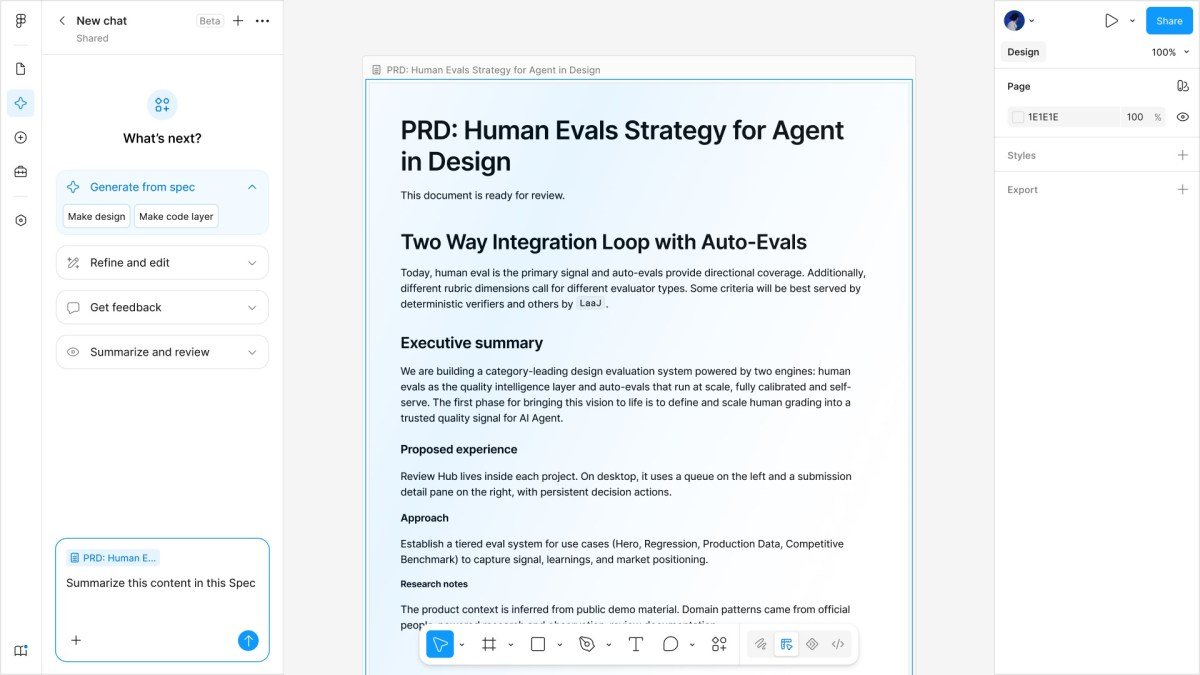
Figma AI agents gained a powerful new framework during Config India this week. The company introduced Figma Specs, a Markdown editor that codifies design language into machine-readable rules. First, teams can author these specifications as independent files or embed them within existing canvases. Second, the editor accepts references to canvas elements, FigJam diagrams, and code snippets, creating living documentation that evolves with the product.
Design libraries, code libraries, and guidelines now feed into a centralized context system. Moreover, agents consult this repository to ensure outputs align with brand standards. Loredana Crisan, chief design officer, emphasized that modern teams write vast amounts of exploratory code. She revealed that code volume has grown 17-fold while release frequency increased only 1.3 times, suggesting most code serves discovery rather than delivery.
Figma AI Agents: Interactive Prototypes Via Code Layers Feature
Code layers graduate from private to public beta, letting Figma AI agents write and edit code on the canvas. Designers can prompt agents to convert static mockups into interactive prototypes or tweak specific functions. Consequently, the feedback loop between ideation and validation tightens significantly. However, the company cautions that AI unpredictability requires guardrails, which Specs documents provide.
Meanwhile, the agent-on-canvas feature rolled out to a broader user base last week. This expansion lets more teams experiment with AI-assisted design while the steering mechanisms mature. For instance, a designer might specify button states in Specs, then ask the agent to implement hover effects across dozens of components automatically.
Payload Acquisition Enables Content Management
The Payload headless CMS, acquired last year, now integrates with Figma Make for dynamic site generation. Teams manage content directly inside Figma, eliminating context switching between tools. Additionally, Payload’s download rate multiplied six times in the past year, reflecting developer enthusiasm. This move extends Figma’s reach from design into publishing workflows.
India’s strategic importance drove Figma to establish its first local office in late 2024. The hub handles sales, partnerships, and product support for the platform’s largest non-US market. Ultimately, this investment underscores the region’s role in shaping global design trends.
Model Context Protocol Adds Developer Tools
Support for the Model Context Protocol now covers over 20 tools, including Open Code, Dia, Grok Bot, and Sarvam. This standardization lets Figma AI agents exchange context with external applications seamlessly. In addition, developers can build custom integrations that respect design system constraints defined in Specs. The protocol effectively turns Figma into a programmable layer for the design-to-code pipeline.
Overall, these capabilities transform Figma into a decision hub where product teams define, validate, and ship software. By unifying specifications, code, content, and agent orchestration, the platform reduces the fragmentation that plagues modern development. For organizations adopting AI workflows, the toolkit provides structure without stifling experimentation.
For official technical specifications and hardware documentation, visit AMD Official Specifications or MSI Technical Specs.
Figma AI Agents Market Impact and Industry Significance
The introduction of Figma AI Agents represents a pivotal shift in modern technological adoption across enterprise and consumer sectors alike. Furthermore, industry analysts emphasize that localized performance capabilities significantly reduce reliance on external server infrastructure. Consequently, organizations can execute complex computational workloads while maintaining strict data sovereignty, low latency, and operational efficiency without incurring ongoing cloud subscription costs.
Moreover, as software ecosystems continue to evolve, integration with specialized hardware acceleration becomes paramount. Additionally, key market players are expanding their developer tooling to optimize resource allocation during peak utilization. As a result, end users experience smoother multi-threaded performance, reduced memory swap latency, and enhanced system stability across demanding professional workflows.
Performance Benchmarks and Practical Figma AI Agents Scenarios
In real-world deployment scenarios, evaluating sustained throughput and thermal efficiency is essential for technical decision-makers. Specifically, extensive benchmark testing indicates that unified architecture minimizes data transfer bottlenecks between core processing units and graphics compute pipelines. Therefore, demanding tasks operate with minimal compute overhead.
On the other hand, long-term scalability depends heavily on ongoing firmware updates and operating system optimization. Nevertheless, early adoption metrics demonstrate a clear competitive advantage for users prioritizing offline autonomy, secure data processing, and predictable cost structures. Ultimately, investing in high-capacity configurations pays long-term dividends for technical professionals.
Ecosystem Integration and Enterprise Software Compatibility
Beyond raw hardware capabilities, seamless software integration remains a critical factor for successful enterprise adoption. Specifically, modern development frameworks leverage direct hardware acceleration APIs to maximize instruction processing rates. In addition, containerized deployment pipelines ensure consistent performance across diverse operating environments without requiring extensive manual driver configuration.
Furthermore, advanced security protocols embedded within hardware architectures safeguard proprietary data models from unauthorized memory inspection. Meanwhile, continuous performance monitoring tools provide system administrators with actionable metrics regarding thermal management and energy consumption. Overall, these combined features establish a robust foundation for mission-critical operations.
