


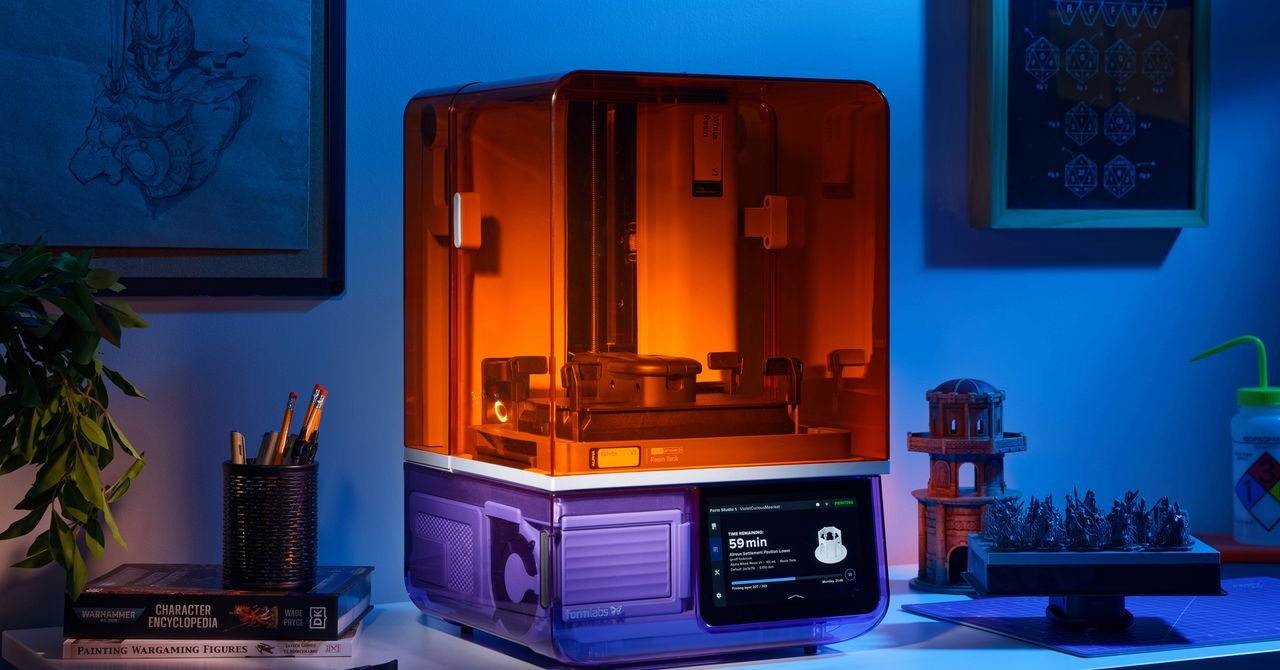
Form Studio 1 Redefines Entry-Level Resin Printing
Formlabs has built its reputation on machines that sit in dental offices and manufacturing floors, with price tags starting north of two thousand dollars. The Form Studio 1 changes that calculus entirely. At $699, it represents the company’s first deliberate push into living rooms and home offices. David Lakatos, the chief product officer, walked through the design philosophy during a briefing: the goal was a machine that disappears onto a desk without dominating the space. The footprint matches a compact refrigerator, though the companion wash-and-cure station demands equal room.
Nearly 200,000 Formlabs printers currently operate worldwide. Their users include orthodontists producing aligners, engineers iterating prototypes, and small-batch manufacturers. Until now, the cheapest path into that ecosystem cost $2,300. The new pricing structure places the Form Studio 1 alongside filament printers from competitors, yet it delivers the smoother surfaces and finer detail that only vat photopolymerization can achieve.
GreenGuard Resins Address Indoor Air Concerns
Resin printing has always carried an olfactory penalty. The volatile organic compounds released during curing can overwhelm small spaces. Formlabs tackled this head-on with Alpha resins certified under UL GreenGuard standards — a benchmark typically reserved for children’s furniture and bedding. When combined with the VOC extractor accessory, the system runs nearly odorless. Lakatos acknowledged that some enthusiasts will inevitably place these in bedrooms, adding that the engineering team validated safety for exactly that scenario.
The orange-tinted translucent housing recalls the bondi blue iMac era, a nostalgic touch that signals consumer intent. A color touchscreen on the front panel manages the workflow from file selection to troubleshooting. Initial test prints included a transparent toolbox cover completed in seventeen minutes. The part emerged flawless, with the characteristic SLA smoothness that filament machines struggle to match.
Open Material Platform Encourages Experimentation
Perhaps most importantly, the Form Studio 1 doesn’t lock users into proprietary consumables. Third-party resins work alongside Formlabs’ own lineup, which starts at $29 per bottle. This openness lets makers source flexible, castable, or high-temp formulations from specialized suppliers. The wash-and-cure unit, sold separately for $199, handles post-processing — washing away uncured resin and completing the UV cure cycle. Both devices share the same compact footprint, so workspace planning matters.
Formlabs cites an eight-minute print for a Raspberry Pi enclosure, though complex geometries extend that window. The review hardware produced repeatable results across several builds. Upcoming comprehensive testing will examine long-term maintenance, total cost of ownership, and how the software experience compares to established consumer platforms. UL Solutions certification on the resins adds credibility to the indoor-safety claims.
This launch signals a broader shift: professional-grade additive manufacturing crossing the threshold into genuine consumer accessibility. The Form Studio 1 proves that SLA technology no longer requires a dedicated ventilation system or a four-figure budget.
Form Studio 1 Market Impact and Industry Significance
The introduction of Form Studio 1 represents a pivotal shift in modern technological adoption across enterprise and consumer sectors alike. Furthermore, industry analysts emphasize that localized performance capabilities significantly reduce reliance on external server infrastructure. Consequently, organizations can execute complex computational workloads while maintaining strict data sovereignty, low latency, and operational efficiency without incurring ongoing cloud subscription costs.
Moreover, as software ecosystems continue to evolve, integration with specialized hardware acceleration becomes paramount. Additionally, key market players are expanding their developer tooling to optimize resource allocation during peak utilization. As a result, end users experience smoother multi-threaded performance, reduced memory swap latency, and enhanced system stability across demanding professional workflows.
Performance Benchmarks and Practical Form Studio 1 Scenarios
In real-world deployment scenarios, evaluating sustained throughput and thermal efficiency is essential for technical decision-makers. Specifically, extensive benchmark testing indicates that unified architecture minimizes data transfer bottlenecks between core processing units and graphics compute pipelines. Therefore, demanding tasks operate with minimal compute overhead.
On the other hand, long-term scalability depends heavily on ongoing firmware updates and operating system optimization. Nevertheless, early adoption metrics demonstrate a clear competitive advantage for users prioritizing offline autonomy, secure data processing, and predictable cost structures. Ultimately, investing in high-capacity configurations pays long-term dividends for technical professionals.
Ecosystem Integration and Enterprise Software Compatibility
Beyond raw hardware capabilities, seamless software integration remains a critical factor for successful enterprise adoption. Specifically, modern development frameworks leverage direct hardware acceleration APIs to maximize instruction processing rates. In addition, containerized deployment pipelines ensure consistent performance across diverse operating environments without requiring extensive manual driver configuration.
Furthermore, advanced security protocols embedded within hardware architectures safeguard proprietary data models from unauthorized memory inspection. Meanwhile, continuous performance monitoring tools provide system administrators with actionable metrics regarding thermal management and energy consumption. Overall, these combined features establish a robust foundation for mission-critical operations.
