


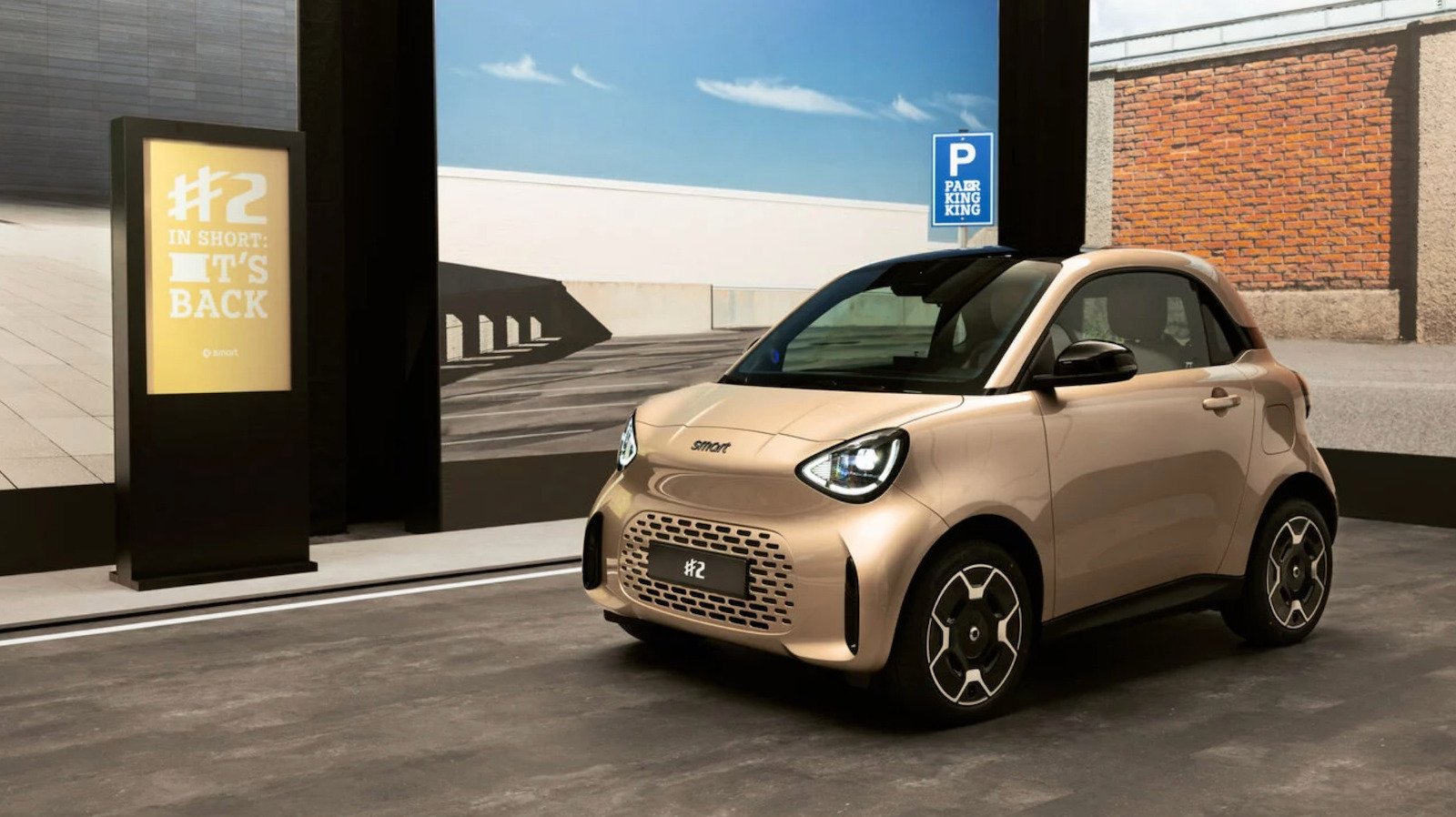
Smart #2 EV Unveiled as Urban-Focused Commuter
At the Paris Motor Show, the Smart #2 EV emerged as a purpose-built city car measuring merely 2.7 meters bumper-to-bumper. This dimension enables parking in spaces that would challenge larger vehicles, a critical advantage in dense metropolitan areas. Furthermore, the rear-wheel-drive layout employs a 60kW motor generating 130Nm of torque, while staggered tire widths — wider at the rear — contribute to composed handling characteristics. As a result, the platform prioritizes agility over outright acceleration, aligning with typical urban driving patterns.
Exterior styling draws clear inspiration from the Fortwo heritage, featuring two-tone paint options and a cab-forward silhouette. Inside, however, the cockpit adopts contemporary expectations. Dual displays dominate the dashboard: a 10.1-inch infotainment screen and an 8.8-inch instrument cluster. Moreover, standard connectivity includes 4G, Wi-Fi, and Bluetooth, enabling over-the-air updates and smartphone integration. Driver assistance features also ship on every variant, raising the safety baseline for the segment.
Smart #2 EV: Battery Range and Charging Performance
The lithium-ion pack integrated into the floor structure delivers 180 miles (290 km) of WLTP-rated range, sufficient for several days of typical commuting. Additionally, DC fast charging support permits a 10-to-80 percent top-up in approximately 20 minutes, minimizing downtime during longer journeys. Meanwhile, the five-link independent rear suspension replaces the Fortwo’s simpler torsion beam, promising superior ride compliance over irregular pavement. According to ACEA data, European charging networks have expanded 40% since 2022, improving practicality for city EVs.
Equipment Tiers and Limited Edition
Buyers choose from four escalating trim levels. The base Pure covers essentials, while Pure+ upgrades to 11kW AC charging and adds a heated driver seat. Subsequently, the Premium grade bundles a glass roof, heated leather seats, and a Sennheiser seven-speaker sound system. At the summit, the Couture Edition caps production at 999 units worldwide, distinguished by exclusive gold exterior accents and unique badging. Importantly, mechanical specifications remain identical across the range, ensuring consistent driving dynamics.
European Launch Timeline and U.S. Absence
Pricing starts under $26,500 (£20,000), positioning the Smart #2 EV below most compact electric alternatives. Preorders commence this spring with customer deliveries beginning in summer. However, Smart withdrew from the American market in 2019, and current consumer preferences favoring larger vehicles make a return improbable. Ultimately, the Smart #2 EV demonstrates that ultra-compact electric mobility remains viable, even as industry trends shift toward bigger platforms.
Smart #2 EV Market Impact and Industry Significance
The introduction of Smart #2 EV represents a pivotal shift in modern technological adoption across enterprise and consumer sectors alike. Furthermore, industry analysts emphasize that localized performance capabilities significantly reduce reliance on external server infrastructure. Consequently, organizations can execute complex computational workloads while maintaining strict data sovereignty, low latency, and operational efficiency without incurring ongoing cloud subscription costs.
Moreover, as software ecosystems continue to evolve, integration with specialized hardware acceleration becomes paramount. Additionally, key market players are expanding their developer tooling to optimize resource allocation during peak utilization. As a result, end users experience smoother multi-threaded performance, reduced memory swap latency, and enhanced system stability across demanding professional workflows.
Performance Benchmarks and Practical Smart #2 EV Scenarios
In real-world deployment scenarios, evaluating sustained throughput and thermal efficiency is essential for technical decision-makers. Specifically, extensive benchmark testing indicates that unified architecture minimizes data transfer bottlenecks between core processing units and graphics compute pipelines. Therefore, demanding tasks operate with minimal compute overhead.
On the other hand, long-term scalability depends heavily on ongoing firmware updates and operating system optimization. Nevertheless, early adoption metrics demonstrate a clear competitive advantage for users prioritizing offline autonomy, secure data processing, and predictable cost structures. Ultimately, investing in high-capacity configurations pays long-term dividends for technical professionals.
Ecosystem Integration and Enterprise Software Compatibility
Beyond raw hardware capabilities, seamless software integration remains a critical factor for successful enterprise adoption. Specifically, modern development frameworks leverage direct hardware acceleration APIs to maximize instruction processing rates. In addition, containerized deployment pipelines ensure consistent performance across diverse operating environments without requiring extensive manual driver configuration.
Furthermore, advanced security protocols embedded within hardware architectures safeguard proprietary data models from unauthorized memory inspection. Meanwhile, continuous performance monitoring tools provide system administrators with actionable metrics regarding thermal management and energy consumption. Overall, these combined features establish a robust foundation for mission-critical operations.
