


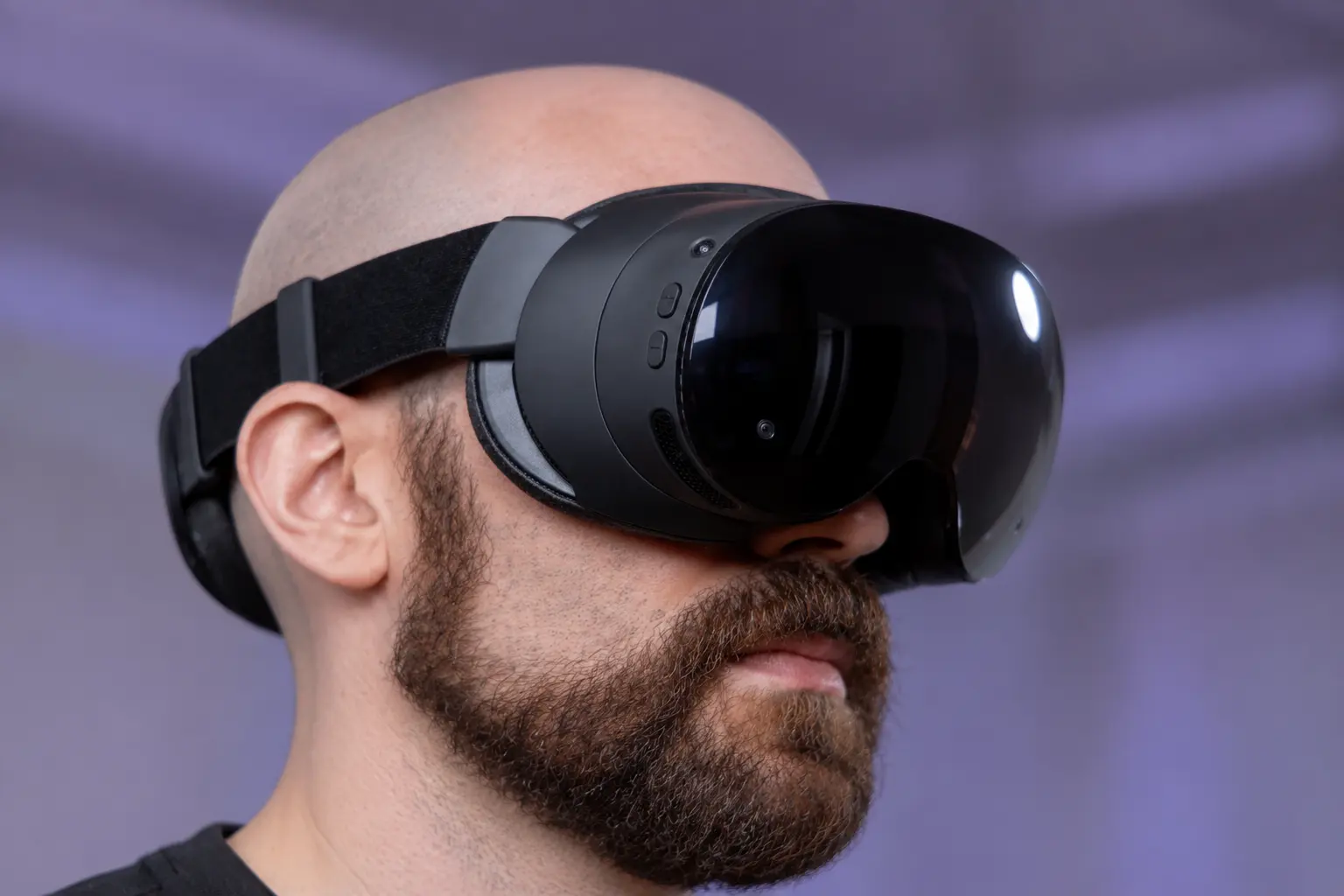
Virtual reality gaming has been running low on momentum for a while now, and the Steam Frame VR headset just arrived as one of the few genuinely fresh ideas in the space. Valve built the device to be wireless-first, but that convenience comes at a cost: battery life takes a real hit once you start running native 2D or VR titles for extended sessions.
Passthrough is another mixed bag. The headset’s infrared cameras only render the outside world in monochrome, which makes augmented reality content feel more like a compromise than a feature. However, judging the Steam Frame purely on its out-of-the-box specs misses the bigger picture. Underneath the hood, it’s essentially a wearable Linux PC — and that opens the door to a level of modularity most headsets simply don’t offer.
A PCI-E Slot That Changes the Equation
Valve didn’t just ship a closed device. At launch, the company promoted a $150 add-on built by Arcturus that plugs straight into the headset’s PCI-E expansion slot. Once attached, it unlocks full-color RGB passthrough and 3D video capture, both of which were missing from the base hardware.
Hands-on demo footage shows how much of a difference this makes for mixed-reality gameplay. More importantly, it signals something bigger: developers now have a physical pathway to extend what the Steam Frame can do, rather than waiting on Valve to bake every feature into the headset itself.
That expansion slot is the real story here. As a result, third-party manufacturers have an open invitation to build hardware Valve never planned for, which could keep the ecosystem evolving long after launch-day reviews fade.
Independent Developers Are Already Experimenting
Third-party interest isn’t just theoretical. Indie hardware company Soulart is developing infrared base stations designed to work independently of any single headset, and it has publicly stated compatibility with the Steam Frame is part of the plan. Unlike Valve’s own tracking system, which needs no external base stations, this setup targets a more specific crowd — largely VRChat users chasing precise full-body avatar tracking.
It’s a niche use case, admittedly. Still, it proves outside developers see enough potential in the Steam Frame’s open design to build for it voluntarily, and that kind of grassroots support is exactly what a struggling VR market needs right now.
Valve’s Own Upgrade Path
Valve isn’t leaving all the innovation to outside partners, either. The company confirmed to PCGamer that it’s developing a new headstrap featuring a hot-swappable battery and upgraded speakers, echoing the audio quality from its 2019 Index headset.
This matters because it changes the usual upgrade cycle for VR hardware. Instead of forcing players to wait years for a next-generation headset, Valve can roll out meaningful improvements as add-ons to gear people already own. For a shrinking VR market, that kind of flexibility could buy the platform real time.
Why VR Still Needs Saving
None of this modularity guarantees mainstream success. At $1,060, the Steam Frame is priced well beyond what casual buyers will consider, especially compared to how accessible the Meta Quest line once was. Meanwhile, the broader VR industry keeps losing ground.
Sony appears to have quietly stepped back from the PlayStation VR2 just three years after launch, with major retailers — including PlayStation Direct — now listing it as out of stock or available only used. Rising component costs haven’t helped either; ballooning RAM prices have pushed VR hardware further out of reach for budget-conscious gamers.
Game studios are feeling the squeeze too. Polyarc, the developer behind the acclaimed Moss series, shut down the week before the Steam Frame launched. Months earlier, Vertigo Games’ Amsterdam studio — creators of Metro Awakening — closed for similar reasons, citing an increasingly difficult VR market.
Competition from the AR and smart-glasses space adds more pressure. Meta is reportedly working on a headset-glasses hybrid, “Project Phoenix,” expected around its September 23 Meta Connect event, while Google and XReal’s Project Aura glasses are chasing similar territory. Neither appears to be built primarily for gaming, though, which leaves an opening for the Steam Frame VR headset to matter to players specifically.

1 Comment
Pingback: GoPro Mission 1 Pro ILS Review: Skip It for the Pro - techdrogo.com