


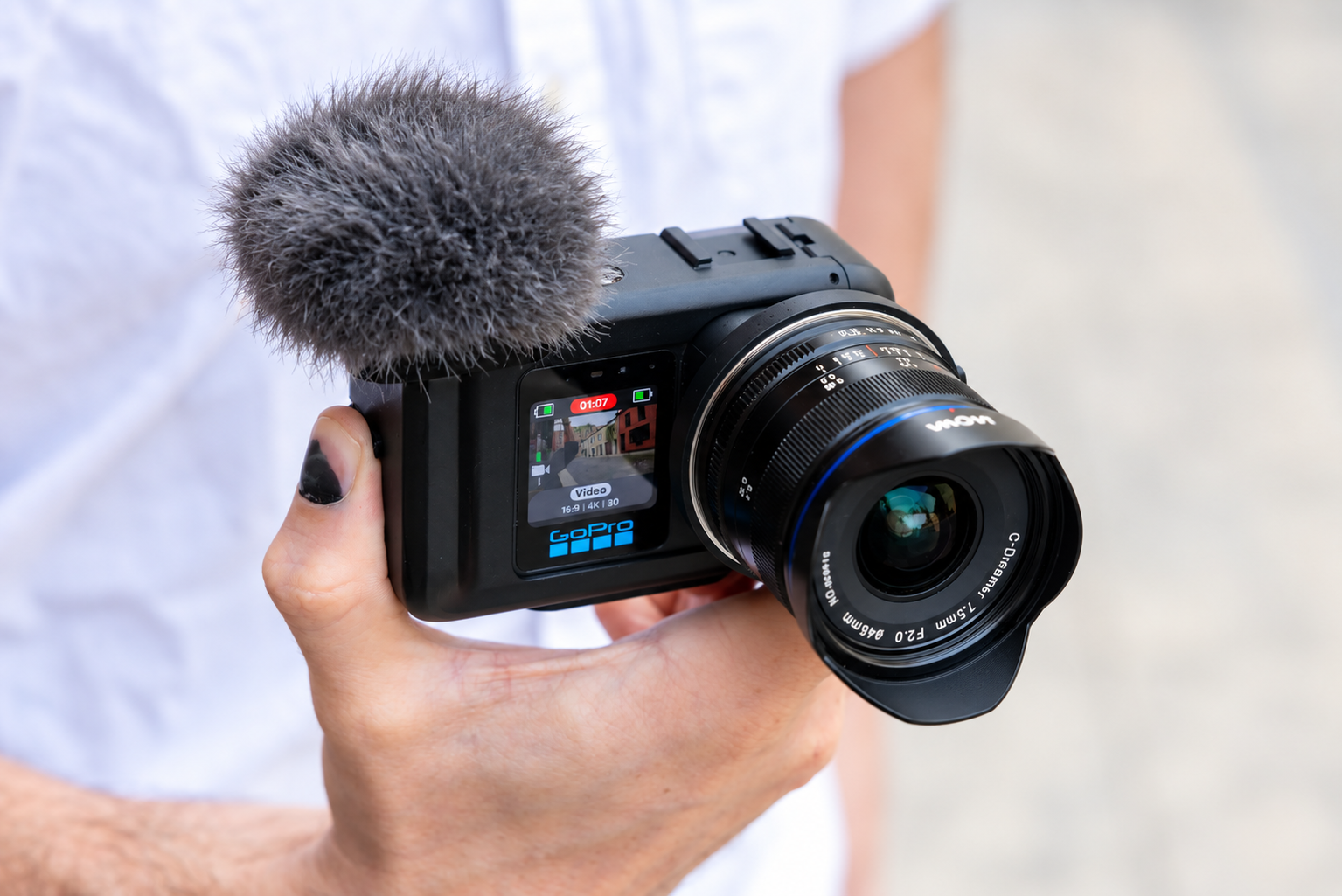
This GoPro Mission 1 Pro ILS review starts with a blunt verdict. GoPro built the first action camera that accepts third-party lenses, and the idea sounds exciting. In practice, the camera loses much of what makes a GoPro useful. It also falls short of what professionals expect from a lens-swapping body.
The ILS costs $700, the same as the standard Mission 1 Pro. For that price, buyers give up several features and gain a lot of hassle.
What the ILS Model Is Supposed to Do
The ILS uses a micro four-thirds mount. As a result, you can fit lenses from other brands instead of relying on a single built-in wide-angle view. GoPro lists around 45 compatible lenses from several makers.
The camera keeps the classic GoPro magnetic mount and 1/4-inch threads. That is about the only traditional GoPro strength it retains. Unlike the standard model, it is not waterproof, and GoPro calls it “weatherproof” instead. It also lacks horizon lock and subject tracking.
Image Quality Still Impresses
Not everything disappoints. The ILS shares the 1-inch sensor of the Mission 1 Pro, so bright outdoor footage looks great. Low-light clips also hold up well.
Swappable lenses add a useful benefit. The footage looks flatter, so you avoid the fish-eye effect unless you want it. The camera also records 10-bit color, which helps with editing.
The shooting specs are strong too:
- 8K at up to 60 fps in standard 16:9
- 8K at up to 30 fps in 4:3 Open Gate mode
- 4K slow motion at up to 240 fps
- 1080p “Burst slo-mo” at 960 fps for up to 10 seconds
Photos benefit as well. The standard model limits RAW photos to a wide angle, but the ILS does not. However, each 50-megapixel photo still takes several seconds to process. That delay frustrates anyone who wants to shoot quickly.
Why the GoPro Mission 1 Pro ILS Struggles With Lenses
The lens system sounds flexible, yet it creates most of the problems. The camera has no electronic contacts, so it cannot talk to the lens. Autofocus does not exist, and electronic focus systems will not work at all.
You must focus by hand for every shot. You also need to enter the focal length in the settings menu each time you change lenses. A zoom lens makes this worse, because you must treat every focal length as a separate prime lens.
The reviewer tested the camera with several lenses. The Laowa 7.5mm f/2 prime worked well. A glow on the small 2.59-inch OLED screen helped confirm focus. In contrast, the M.Zuiko 14-42mm zoom would not focus, and the M.Zuiko 25mm gave the same trouble. As a result, most of the test footage came from the Laowa alone.
GoPro also recommends compact lenses below f/4.5. Larger lenses can cause softness from diffraction.
Handheld Shooting Takes a Step Backward
The ILS also stabilizes footage less effectively than the Mission 1 Pro. Hypersmooth is available, but it forces a 10% crop. Meanwhile, a longer lens throws off the balance of the short, stocky body. Every bump turns into shaky footage that takes extra work to fix.
Vloggers will notice this problem quickly. Many creators have already moved to the Osmo Pocket 4 or the pricier Insta360 Luna Ultra for this reason.
The ILS also drops the timelapse mode. A sunrise clip means recording close to 20 minutes of video and trimming it later. Alternatively, you can shoot interval photos every three seconds and stitch them together.
Controls and Audio Add More Friction
Professionals usually want physical dials or buttons. The ILS offers only a touchscreen, even with GoPro’s accessories. White balance and ISO are available, along with three shutter speeds: 1/120, 1/240, and 1/360. Adjusting any of them on the fly feels slow.
GoPro’s Media Mod helps in some ways. It plugs into the USB-C port and adds a mic with a built-in pop filter. It also includes a 3.5mm mic jack with 32-bit float recording, a headphone port, and micro-HDMI output at 4K 60 fps. Two cold shoes give you room for accessories.
Pairing GoPro’s Wireless Mic System was another story. The reviewer found a DJI Mic 3 easier to connect to a DJI camera than GoPro’s own mic to this camera.
Battery Life Is a Bright Spot
Early beta software drained the battery too quickly. Fortunately, the final release fixed the issue. The ILS uses the same larger battery as the Mission 1 Pro and runs for a little under three hours at 4K, switching between 30 and 60 fps. GoPro also sells a separate battery charger for longer shoots.
Who Should Buy It?
Honestly, very few people. A static shot in the desert on a GoPro mount might suit it. Otherwise, it works poorly as an action camera, a vlogging camera, or a photo camera.
The company’s situation adds some uncertainty. According to Gizmodo, GoPro has struggled against Insta360 and DJI. The report also says the company sold itself to Starman Optical for $285 million, and that CEO Nick Woodman promised the brand would continue.
For now, the standard Mission 1 Pro is the better choice at the same price.
Frequently Asked Questions
How much does the GoPro Mission 1 Pro ILS cost?
It costs $700 without a lens. The regular Mission 1 Pro costs the same.
Is the GoPro Mission 1 Pro ILS waterproof?
No. GoPro describes it as weatherproof, not waterproof.
Does the ILS have autofocus?
No. The camera has no electronic lens contacts, so you must focus manually.
Does the ILS support timelapse?
No. The timelapse mode from the Mission 1 Pro is missing. Interval photos are the closest alternative.
Is the ILS better than the Mission 1 Pro?
Mostly not. It gives you flatter footage and better RAW photos. However, it has weaker stabilization and fewer shooting modes.
